What Is a Cradle to Cradle Certified Backpack? Tiers, Fabric vs Bag, and What to Check
By Chester Takau · November 2026
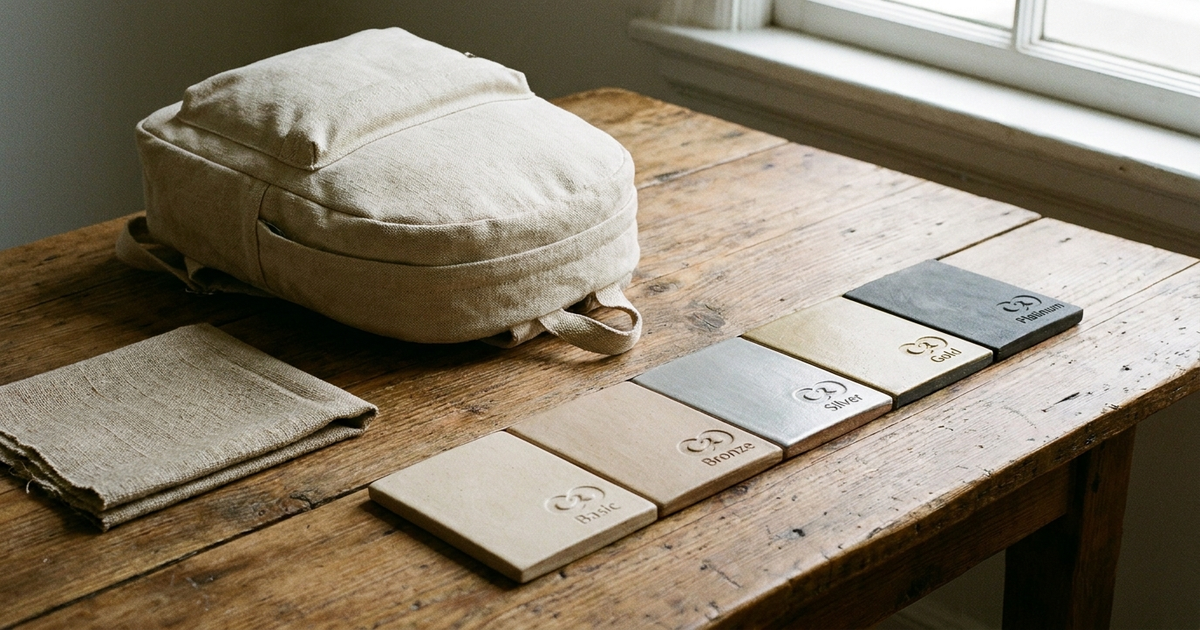
A Cradle to Cradle (C2C) Certified backpack is a finished bag whose design has been assessed against the C2C Certified standard and awarded a level: Basic, Bronze, Silver, Gold or Platinum. The overall level equals the product's weakest category, so one poor score caps the whole rating. Most "C2C" bags on sale are not certified as bags. They use a certified fabric, and that is a different claim.
Chester Takau writes about sustainable school gear from a Pacific-Island perspective, decoding eco-certifications so buyers can tell real claims from greenwashing.
How the five levels work
C2C is the only common bag-related certification that grades by level. GOTS, OEKO-TEX, GRS and bluesign are pass/fail. With C2C the product is scored in several categories and the lowest score sets the final level (official standard). A bag with Platinum material health and Bronze circularity is a Bronze bag.
Version 5.0 took effect on 2026-03-16 after release on 2026-02-10. It adds three pathways: Full Scope, Material Health and Circularity. New applications and renewals use it (USB Certification). So "Gold" on a label now needs a second word to mean anything.
| Claim on a bag listing | What was assessed | Real example |
|---|---|---|
| "C2C Certified Gold" on the product page | The whole product, all scored categories (Full Scope) | Accoya wood: Full Scope Gold under v5.0, valid to October 2029. No backpack found. |
| "Circularity Gold" | The circularity pathway only | Crocs Classic Clog, 29-42% recycled content (mass-balance), announced 2026-11-04 |
| "Made with C2C Certified fabric" | The textile only, not zips, buckles, foam or stitching | Bananatex: Gold since December 2021, Platinum for Material Health. Used in about 60 QWSTION products. |
| "Circular design" | Nothing by C2C. It is the brand's own claim. | FREITAG MONO[PA6]: all polyamide 6 with a take-back scheme. I found no source saying it is C2C certified. |
The table is my own reading of the sources below, not an official C2C breakdown. I could not find a published, bag-specific list of what each tier demands, so I'm not going to invent one.
Which tiers show up on school gear?
Almost none, as far as I can find. Eco-backpack roundups list B Corp, GOTS, Fair Trade and GRS bags and name no C2C-certified backpack. On 2026-11-16 the C2C Institute launched its "One Choice" campaign with eight brands: Ahrend, Shaw Industries, Kawneer, Blueland, Dopper, G-STAR, Crocs and RE&UP. No bag brand is among them (commentary, 2026-11-18). The tier you will actually meet is Gold on a fabric, via Bananatex, made from abacá banana fibre.
Is a certified fabric as tough as nylon?
Carryology says Bananatex is "still not at the level of Cordura" for strength and abrasion resistance, but "more than enough for your daily carry". Its road test of the Roll Pack named the metal zip as the weakest part, which is a good reminder that the certificate covered the cloth, not the hardware (Carryology).
The video is FREITAG's account of building a single-material backpack that can be recycled whole. It is a circular-design example, not a C2C-certified one, which is exactly the distinction worth keeping straight. Even a well-designed circular bag only helps at end of life if it actually comes back, so where to donate used school bags is the practical next step for the ones that don't.
What are the criticisms?
- Independence. BuildingGreen called the older MBDC-run scheme a "black box" and said some peers doubted it was truly third-party. It did not allege blatantly misleading claims (BuildingGreen). Brands also choose to apply, and the certifier's own organisation verifies conformity (Elemental Green).
- Cost. One guide estimates roughly $5,000-$15,000 depending on material complexity and SKU count, which favours large companies over small bag makers (Package the World).
- Awareness. A critic doubts most shoppers can explain the label, though the author admits he found no study on it.
How to check a bag yourself
Ask three questions. Is the certificate for the bag or only the fabric? Which pathway and level is it, and which version? When does it expire? Look the product up in the official C2C registry (Bags category) rather than trusting a logo on a hang tag. If the brand can't point to a registry entry, treat the claim as unverified.
Sources
- C2C Certified Full Scope standard
- USB Certification: Version 5.0 enters into effect
- C2CPII: Inside Bananatex
- Crocs: Circularity Gold for the Classic Clog
- Timber Media: Accoya Full Scope Gold under v5.0
- Carryology: Is Bananatex the next miracle backpack fabric?
- Design Milk: FREITAG MONO[PA6]
- BuildingGreen: C2C certification, a peek inside
- Elemental Green: What does C2C Certified mean?
- Package the World: certification cost guide
- Walter Susini: One Choice commentary
Updated November 2026.
Transparency note: This article was researched and written by Chester Takau with AI assistance for research gathering and drafting. All recommendations reflect the author's own editorial judgment.
Comments
Post a Comment