GOTS vs OEKO TEX Difference: What Each Certification Actually Checks in 2026
By Chester Takau · July 2026
🏷️ Eco-Certification Decoder
Sustainability labels don't all mean the same thing. Select one or two to see what each actually verifies — and what it doesn't.
Summaries of what each standard checks, for general buyer education. Always confirm a certificate is current and covers the specific product, not just the brand.
What GOTS actually certifies
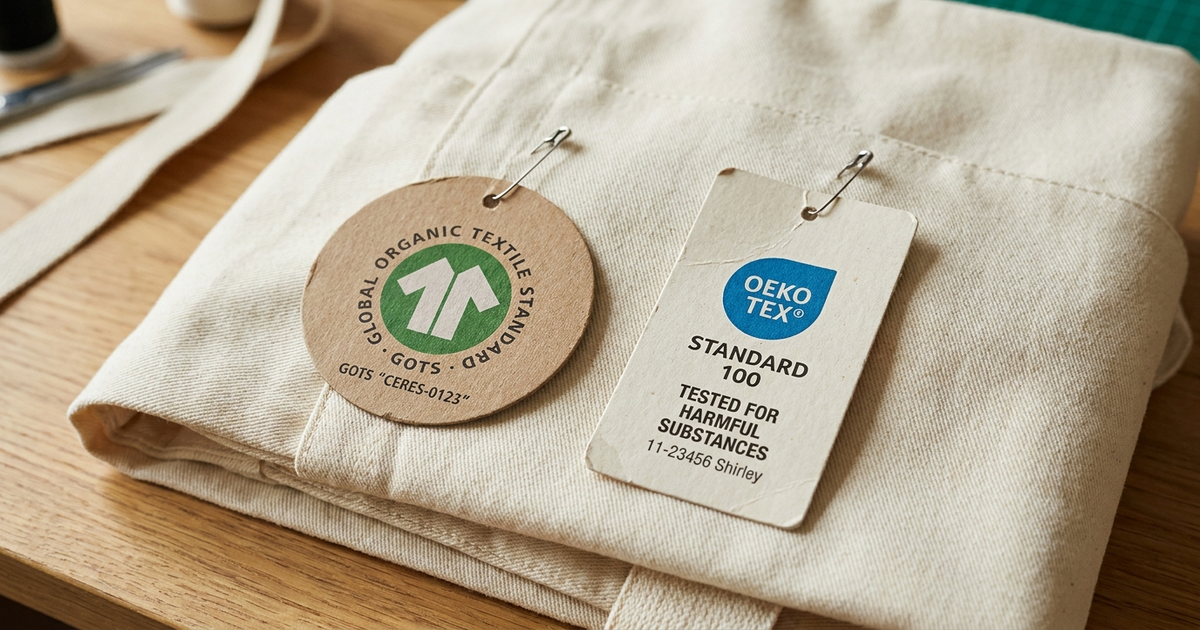
The Global Organic Textile Standard tracks a product from the farm gate to the finished item on a shelf. It requires a minimum of 70% certified organic fiber ("made with organic") or 95% ("organic"), bans a defined list of hazardous chemical inputs at every processing stage, requires wastewater treatment at wet-processing facilities, and — separately from the fiber question — audits labor conditions across the entire supply chain against International Labour Organization criteria. That last part is the piece most shoppers don't realize is bundled in: a GOTS label is also a labor-standards claim, not just a fiber claim. OEKO-TEX STANDARD 100 checks none of this.
What OEKO-TEX actually certifies
OEKO-TEX STANDARD 100 is a lab test, not a supply-chain audit. It screens the finished textile — the one already sewn, dyed, and ready to sell — against a list of well over 1,000 substances that shouldn't be there: formaldehyde, heavy metals, banned azo dyes, phthalates, and PFAS, among others. Limits get stricter by product class, so a certificate on baby clothing means more than one on a decorative cushion cover. Under OEKO-TEX's New Regulations 2025, the organization also launched a dedicated ORGANIC COTTON certification and tightened BPA limits and leather supply-chain transparency — but that's a separate add-on scheme, not something folded into the base STANDARD 100 label. Buy 100% virgin polyester, dye it with compliant dyes, and it can still pass STANDARD 100 and carry the tag.
GOTS vs OEKO-TEX, side by side
| Question | GOTS | OEKO-TEX STANDARD 100 |
|---|---|---|
| What's tested | Whole production chain: fiber, chemical inputs, wastewater, labor | Only the finished product, for chemical residue |
| Requires organic fiber? | Yes — 70% or 95% depending on the tier | No — synthetics and conventional cotton both qualify |
| Covers labor conditions? | Yes, audited against ILO criteria | No |
| Works for polyester/blends? | No — organic fiber is the entry requirement | Yes |
| Typical cost to certify | Higher — annual whole-chain audit plus wastewater checks | Lower — single-product lab test |
Does OEKO-TEX mean the cotton is organic?
No, and this is where most of the confusion sits. STANDARD 100 answers "is this safe against my skin," not "was this grown without pesticides" or "was this fair-trade cotton." OEKO-TEX itself is explicit about the boundary — its own labelling and greenwashing guidance states plainly that STANDARD 100 is a chemical-safety label, not an organic or sustainability claim. The practical trap: a brand can put a STANDARD 100 tag on a 100% polyester sheet set, and a shopper who assumes "certified" means "eco" walks away with a resource-intensive, non-biodegradable product that never claimed to be organic in the first place. That's not OEKO-TEX being dishonest — it's the label being read for more than it says.
Do you need both, or is one enough?
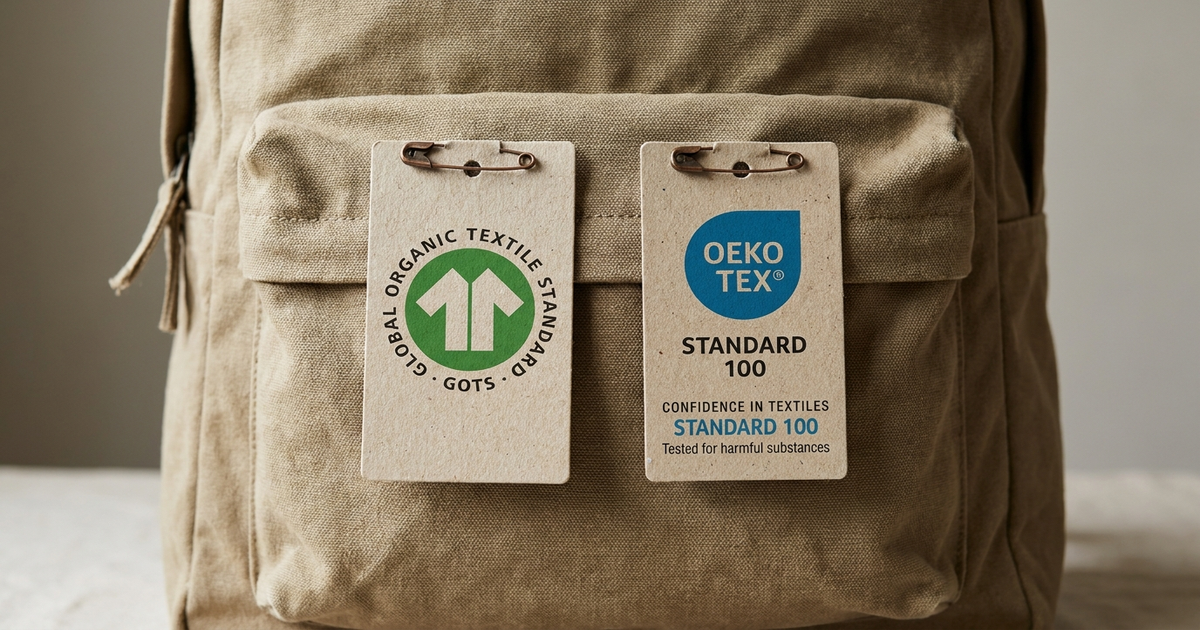
It depends on what you're buying and what you're worried about. For baby items and anything against a newborn's skin, OEKO-TEX's Class I chemical limits are the most directly relevant check — but pairing it with GOTS adds the assurance that the fiber itself wasn't grown or processed with the pesticides and dyes OEKO-TEX doesn't screen for upstream. For underwear, bras, and bedding, OEKO-TEX alone gives real lab-tested reassurance about what's touching skin; GOTS is the add-on if organic fiber and labor conditions matter to you specifically. For backpacks and bags, the calculus shifts again — the fabric body might carry GOTS while the zippers, buckles, and coatings sit outside its scope entirely, which is exactly what our breakdown of what a GOTS backpack label actually covers walks through component by component. Products carrying both marks — organic fiber verified by GOTS, finished-product chemical safety verified by OEKO-TEX — are the closest thing to a complete answer, and it's why the two are routinely marketed together rather than as alternatives.
Why GOTS costs more
The price gap isn't arbitrary. OEKO-TEX STANDARD 100 is a single lab test on a single finished product — send a sample, get results back, certify that batch. GOTS requires an annual on-site audit of every stage a brand controls: the farm's organic certification, the ginning and spinning facilities, the wet-processing plant's wastewater treatment, and a labor audit across all of it. That's why a GOTS-certified item routinely costs more at the register than an OEKO-TEX-only equivalent — the certification is paying for verification of an entire chain, not one test on one output.
What changes in 2026 and 2027
Both standards are mid-revision right now, and the changes push in the same direction — more of the supply chain, not less:
- GOTS Version 8.0, released March 1, 2026, adds annual living-wage gap assessments, a Scope 1 & 2 greenhouse-gas inventory requirement, and OECD-aligned human-rights due diligence. (IDFL)
- 8.0 becomes mandatory for every certified entity on March 1, 2027 after a one-year transition, with GHG enforcement phasing in on the same date. (Cotecna)
- OEKO-TEX's New Regulations 2025 added the standalone ORGANIC COTTON certification, tighter BPA limits under STANDARD 100, and stricter leather supply-chain transparency rules. (OEKO-TEX)
There's a real open question in the trade press about whether GOTS 8.0's new GHG-tracking and living-wage burden pushes smaller producers toward the lighter OEKO-TEX-only route instead of chasing full GOTS status — worth watching as certificates renew through the transition. (just-style)
The video above walks through the same distinction for bedding specifically — why an OEKO-TEX tag alone doesn't mean organic sheets, and why the strongest products in that category carry both marks rather than picking one.
How to check a label before you trust it
Both organizations publish free verification tools rather than asking you to take a hang-tag on faith. GOTS maintains a public database searchable by license or certificate number. OEKO-TEX runs a Label Check tool where you enter a certificate number and confirm it's current. If a product page just says "GOTS certified" or "OEKO-TEX certified" with no number and no way to check, treat it as an unverified marketing claim rather than an audited one — that gap is exactly where greenwashing lives, whether the fabric is a bag, a bedsheet, or a t-shirt. Recycled synthetic materials fall outside both schemes entirely; if what you're evaluating is recycled polyester rather than organic cotton, that's a different standard — our guide to how the recycled-content standard verifies chain of custody covers what that certification actually checks instead.
Neither certification is "better" in the abstract — they're answering different questions, and a lot of the online debate collapses once you separate "was this grown and made responsibly" (GOTS) from "is this safe against my skin right now" (OEKO-TEX). If you're shopping for a laptop bag or backpack rather than bedding or underwear, the certification question usually matters less than basic build quality — our roundup of eco-certified laptop backpacks that actually protect the laptop weighs both factors together rather than certification alone.
Transparency note: This article was researched and written by Chester Takau with AI assistance for research gathering and drafting. All recommendations reflect the author's own editorial judgment.
Comments
Post a Comment