The Secondhand School Supplies Guide: What's Actually Worth Buying Used in 2026
By Chester Takau · July 2026
Not every school supply is worth thrifting, and the guides that tell you to "just buy secondhand" without saying which items skip that advice. The short version: durable goods hold their value used, consumables don't. Below is a category-by-category verdict, built around what's actually changed in 2026 — rising prices, a maturing resale market, and specific rules around which secondhand items schools and test boards will and won't accept.
Why is secondhand suddenly the default instead of the backup plan?
Cost is the driver. The JLL 2026 back-to-school report puts per-child spending at $489, an 11.7% jump from last year, with the National Retail Federation projecting total household spend between $864 and $922. Centier found that outfitting a student now costs roughly 40% more than in 2019, against about 30% general inflation over the same stretch — school supplies specifically have outpaced everyday prices. That's why FinanceBuzz reports 14% of parents now plan to buy secondhand where they can (a figure that's climbed for four straight years), another 28% will reuse what they already own, and 21% will trade down to cheaper basics instead. Sustainability plays a role too — Capital One Shopping found 71% of shoppers now prioritize eco-friendly products — but the honest driver is price, not preference.
The buy-used vs. buy-new decision matrix
This is the piece most guides skip: a straight answer per category instead of a blanket "thrift everything" recommendation.
| Category | Verdict | Why |
|---|---|---|
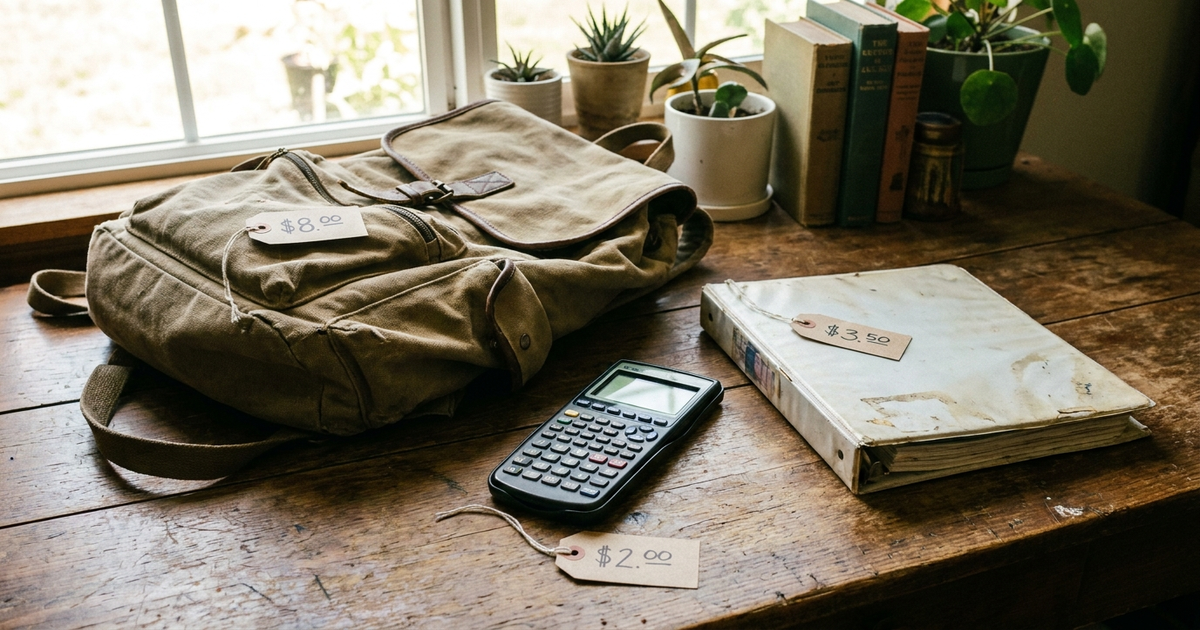
| Backpacks | Buy used | Name brands discounted up to 80% on resale platforms; inspect zippers and straps first |
| Graphing calculators (TI-84, etc.) | Buy used | 40–60% below retail on eBay and Facebook Marketplace; confirm exam-approved model |
| Binders, storage bins, folders | Buy used | Plastic and hard-shell goods don't degrade; a wipe-down is all they need |
| Hardback books, dictionaries, reference texts | Buy used | Content doesn't expire; ThriftBooks and library sales are reliably cheaper than new |
| Scissors, rulers, compasses | Buy used | Metal tools don't wear out; check blades and hinges for rust before buying |
| Lunchboxes and water bottles | Case by case | Hard shells are fine if odor-free; soft insulated linings with mold or cracked seals aren't worth the risk |
| Fill-in workbooks | Case by case | Only worth it if the previous owner's pages are genuinely blank, which is rarely obvious from a listing photo |
| Pencils, pens, glue, crayons, loose-leaf paper | Buy new | Under $1 at Dollar Tree and Five Below; secondhand rarely beats that price and consumables raise hygiene questions |
The pattern holds across the data: Capital One Shopping cites an NRF survey where 40% of back-to-school shoppers said they'd buy secondhand clothing, 28% secondhand electronics, 23% secondhand school supplies, and 20% secondhand shoes — durable categories every time, never consumables. Experts interviewed by Yahoo rank apparel as the single best category to thrift, with school supplies a close second, and note that resale platforms like Poshmark, Depop, and ThredUp discount name brands up to 80% off retail.
Are secondhand graphing calculators actually allowed on exams?
Yes, if you check the model, not just the price tag. WCPO's 2026 back-to-school guide flags TI graphing calculators sold on eBay, Facebook Marketplace, and ThriftBooks at 40–60% below retail as one of the single highest-value secondhand buys available right now — a $150 calculator for $60–$90 is real money back in a family's pocket. The catch is that SAT, ACT, and AP exam calculator policies are tied to specific models, not brands in general, so a used TI-83 or TI-84 Plus is normally fine but a discontinued or non-graphing model may not be. Confirm the exact model against your school's or exam board's current approved list before buying, since a working calculator that gets turned away at the door defeats the savings entirely.
How do I check a used backpack for hidden problems before buying?
Run through zippers, seams, and smell before straps and cosmetics. Pull every zipper fully open and closed — a sticky or misaligned zipper is the single most common reason a secondhand backpack fails within a month. Check the stitching at the base and where straps attach to the body, since that's where a bag under real daily load will tear first. Smell the interior lining directly; mildew odor means moisture got trapped at some point and won't fully air out. Straps should sit even, not stretched on one side, and any bag with a broken buckle is a pass unless the buckle is a simple, common part. This matters more for internal linings than exteriors, since a durable outer shell can look fine while hiding water damage inside. If you'd rather buy new and prioritize the material itself, how to verify a recycled-content claim on a bag's label is worth reading first, since a new "eco" backpack with an unverified claim isn't actually a safer bet than a solid secondhand one.
Where do I actually find secondhand school supplies?
Goodwill and Savers cover the widest general selection, but they're not the only channel and often not the cheapest. Facebook Marketplace and local Buy Nothing groups are frequently free — families offloading last year's binders and backpacks their kid outgrew, not selling them — and they're the most underused channel in most back-to-school advice. Garage sales cluster heavily in the two to three weeks before the local school year starts, and thrift-store shelves are fullest right after that same window, once families have donated what they didn't reuse. Shopping a week or two before the rush, rather than the weekend before school starts, means picking from a fuller shelf instead of whatever's left over.
The segment above frames secondhand shopping around the roughly $250 families now spend on K-12 clothing alone, and treats thrifting as both a budget decision and an environmental one — the same two threads running through most of the 2026 data on this shift. Euronews reports the same trend from the supply side, calling out books, uniforms, and school gear specifically as categories where rising costs are actively growing the used-goods market, which some analysts project could be double the size of fast fashion by 2030.
Is buying secondhand actually more sustainable, or just cheaper?
Both, but they're separate arguments and it's worth keeping them apart. The cost case is straightforward: a used item that already exists costs no new manufacturing, shipping, or packaging, full stop. The "eco" case gets murkier once marketing enters the picture — a new backpack with a recycled-material or sustainability label still required new production, and unless that specific claim carries third-party verification, "sustainable" on a new product is often the weaker choice next to something already in circulation. Families genuinely worried about environmental impact get more certainty from reuse than from an unverified new label, even one written in green.
If I'd rather buy new for a backpack, what should I look for instead?
If a family decides new is the better call — a first backpack for a younger sibling, or a laptop bag that needs padding a used listing photo can't verify — the same durability logic from the matrix above still applies: buy for how long it lasts, not how it looks on day one. Our laptop backpack picks built to protect a student's device for years apply that same standard to new gear, which is useful context even for families thrifting everything else. Schools themselves have a role here too — practical ways a school can steer its supply list toward durable, reusable choices shows how a supply list itself can nudge families toward exactly the kind of purchase that holds up long enough to be worth reselling next year.
How much does secondhand actually save, in real numbers?
Enough to matter against this year's totals. With per-child spending at $489 and total household back-to-school spend projected between $864 and $922, per NerdWallet's 2026 report, shifting even the durable-goods share of that basket — backpack, calculator, binders, a few books — to secondhand at the 40–80% discounts cited above realistically saves $60 to $150 per child before consumables even enter the picture. FinanceBuzz notes 78% of shoppers already expect higher prices this year, which is exactly why the 14% who say they'll buy secondhand has climbed for four consecutive years rather than staying flat — the incentive keeps getting stronger, not weaker.
Transparency note: This article was researched and written by Chester Takau with AI assistance for research gathering and drafting. All recommendations reflect the author's own editorial judgment.
Related on TokMind: Where to Buy Secondhand Backpacks: A 2026 Marketplace-by-Marketplace Guide
Comments
Post a Comment