The GOTS Certified Backpacks Guide: What the Label Actually Covers in 2026
By Chester Takau · July 2026
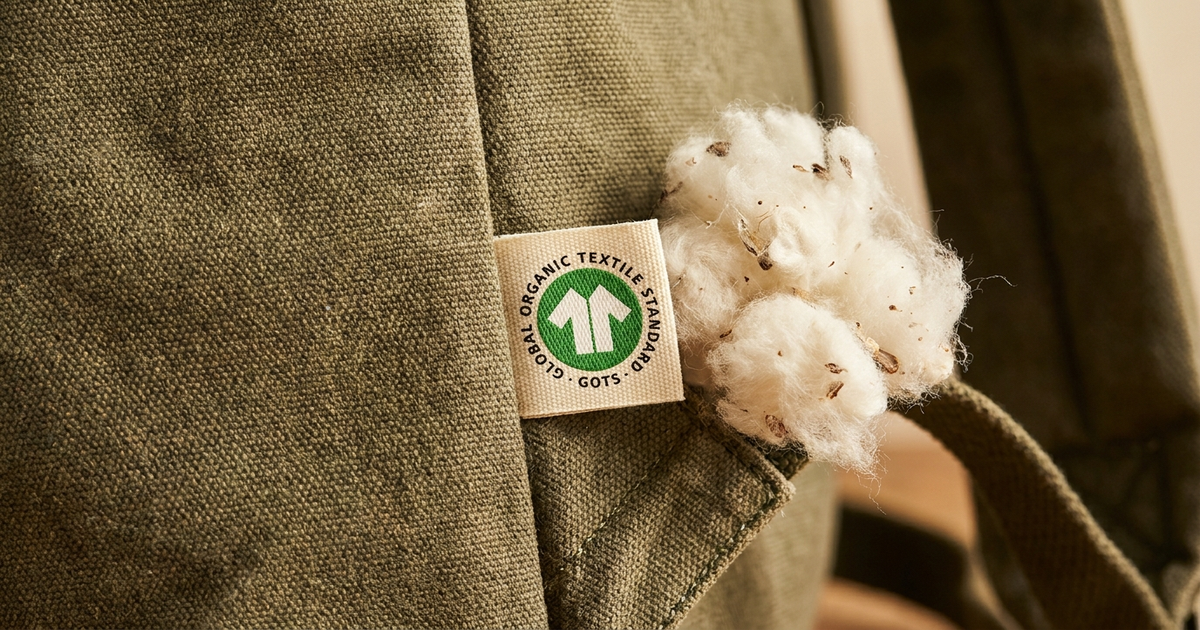
GOTS certification on a backpack means the cotton fabric was grown and processed under audited organic and labor standards — it does not mean the zippers, buckles, foam padding, or coatings were certified, and it says nothing about how long the bag will last. Two label tiers exist: "organic" requires at least 95% certified organic fiber, "made with organic" only needs 70%. Version 8.0 of the standard, released March 1, 2026, adds durability testing and circularity rules that finally connect the certification to the physical bag you're carrying, not just the fabric it started as. Here's what the label actually guarantees, what it doesn't, and how to check a claim before you buy.
The Short Version
GOTS covers the organic fiber and the labor conditions behind it — not the hardware, not the coatings, and until 2026, not durability. "Organic" needs ≥95% certified fiber; "made with organic" only needs ≥70%, so check which one is on the tag. GOTS 8.0 (effective 2026-2027) adds finished-good durability testing, microfibre shedding limits, and OECD-aligned supply-chain due diligence — the first version to actually test the bag rather than just the cloth. It's not a durability guarantee on its own, and it's not the same certification as GRS (recycled content) or OEKO-TEX (chemical residue in the finished item).
GOTS vs OCS vs OEKO-TEX vs Fair Trade, mapped onto a backpack
| Certification | What it actually checks | What it doesn't touch |
|---|---|---|
| GOTS | Organic fiber content (95% or 70% tier), labor conditions across the whole supply chain, residue limits, and — from v8.0 — durability and microfibre shedding | Zippers, buckles, foam padding, transport carbon footprint |
| OCS (Organic Content Standard) | Traceable organic fiber percentage only | Labor conditions, chemical processing, social criteria |
| OEKO-TEX STANDARD 100 | Harmful chemical residue in the finished textile you touch — formaldehyde, heavy metals, PFAS | Fiber origin, whether it's organic, labor standards |
| Fair Trade Certified | Worker wages, premiums, and factory conditions | Fiber content or chemical safety |
None of these four substitutes for another, and a backpack can carry any combination or none of them. If chemical safety in the fabric itself is what you're checking, our OEKO-TEX explainer covers that certification directly, and the Fair Trade Certified guide breaks down what the labor-focused label promises on its own.
What part of the backpack is actually certified?
This is the gap most buyers miss: GOTS certifies the textile — the woven or knitted cotton body of the bag — not every component attached to it. Zippers, buckles, D-rings, laptop-compartment foam, water-resistant coatings, and printed logos sit outside the scope unless a brand has separately certified them (rare, and usually stated explicitly if true). A GOTS label on the hang-tag tells you the fabric passed audit; it says nothing about whether the zipper pull will snap in six months. If a product page just says "organic cotton backpack" without a certification number, treat it as an unverified fiber claim rather than a GOTS one — the two aren't the same thing, even though marketing often blurs them together.
"Organic" vs "made with organic" — which tag is on your bag?
GOTS runs two label tiers, and the difference changes what you're actually buying. A product labeled "organic" must contain at least 95% certified organic fiber. One labeled "made with organic [material]" only needs 70% — the remaining 30% can be conventional cotton or another fiber blended in for stretch, durability, or cost. Both are legitimate GOTS claims, but they're not interchangeable, and the wording is easy to skim past on a product page. If fiber purity is the point of buying organic in the first place, check for the word "organic" alone, not "made with organic," before assuming you're getting the higher tier.
What GOTS 8.0 changes for a backpack you buy this year
GOTS Version 8.0 released March 1, 2026, with a one-year transition and full effectivity by March 1, 2027 — brands can adopt early, so you'll see both old and new certificates in circulation through the transition. The changes that actually matter for a bag buyer:
- Circularity rules — a GOTS-certified backpack can now stay certified through repair, resale, or refurbishment programs, rather than losing its status the moment it changes hands or gets fixed.
- Finished-good durability testing — 8.0 expands technical quality checks on the completed product, not just the raw fabric, which is new for GOTS and directly relevant to whether a certified bag holds up.
- Microfibre shedding limits — new controls on fiber shedding during washing and wear, plus updated residue testing.
- Mandatory OECD-aligned due diligence — supply-chain audits now explicitly cover worker protections against extreme heat and humidity, tightening the labor side of the certification.
Nothing here retroactively upgrades a bag you already own — a certificate issued under the older rules doesn't gain durability testing until it's renewed under 8.0. But it's the first version of GOTS that tries to answer "will this hold up," which has been the standard's biggest gap since it launched.
As GOTS puts it in its own explainer above:
"The GOTS label is your assurance of sustainability and fairness in textiles. You can find the GOTS label in all kinds of textile products."
That framing is accurate as far as it goes — the assurance is about fiber and fairness, which is exactly why it's worth pairing with a chemical-safety label like OEKO-TEX if residue testing on the finished bag matters to you too.
Is a GOTS-certified backpack actually more durable, or are you paying for the label?
Honestly, it depends on construction more than certification, at least until 8.0 certificates fully phase in. Organic cotton canvas isn't chemically hardened the way some conventional finishes are, so owner reports split sharply: some report daily use for four years without failure, others report a thread unraveling from a front pocket within two weeks. Untreated organic cotton is also more vulnerable to rain than a coated synthetic — it can soak through and takes longer to dry — and it tends to attract lint, dust, and pet hair more visibly than smoother synthetic weaves. None of that is a GOTS failure exactly; it's a property of the fiber itself, and it applies whether the cotton is certified organic or conventional. What GOTS 8.0's new durability testing is meant to fix is brands cutting corners on weight and weave density while still qualifying for the fiber-content label — worth watching for as certificates renew under the new rules through 2027.
How do you verify a GOTS claim before you buy?
Look for a certification number and a certifier name printed on the hang-tag or product page — GOTS-approved certifiers include Control Union, Ecocert, and GCS, among others. GOTS maintains a public database where you can search by license or certificate number to confirm it's active and matches the brand. As of 2026, the standard covers 15,441 certified facilities across 87 countries, so a real claim should trace back to one of them. If a listing says "GOTS certified" with no number, no certifier, and no link to check, that's the gap between a real claim and a marketing one — the standard itself has spent its 20th anniversary explicitly campaigning against exactly this kind of vague labeling.
Are ocean-plastic bags like GOT BAG GOTS certified?
Not in the way a cotton canvas bag would be — GOTS certifies organic fiber, and recycled ocean plastic isn't an organic fiber at all. Brands like GOT BAG, which build backpacks from recycled ocean plastic, typically pursue a different certification track — GRS (Global Recycled Standard) is the one that actually verifies recycled content and chain of custody for that material, which our GRS certification guide covers in full. A brand can combine GOTS-certified organic cotton lining or straps with a GRS-certified recycled-plastic body, but the two certifications are answering different material questions, and neither one implies the other. If a recycled-plastic bag's marketing leans on the word "organic," that's worth double-checking against which certification is actually on file.
GOTS is a real, audited standard — annual on-site audits and a public certificate database are what separate it from a self-declared "eco-friendly" claim, and that traceability is the whole reason it's worth checking for. But it isn't a full sustainability verdict on a backpack, and it isn't a durability guarantee outside of the 8.0 rules now phasing in through 2027. If chemical safety in the hardware and coatings matters to you as much as the fiber, our bluesign explainer covers the certification built specifically for that gap.
Transparency note: This article was researched and written by Chester Takau with AI assistance for research gathering and drafting. All recommendations reflect the author's own editorial judgment.
Comments
Post a Comment