How to Repair School Bag Damage: Zippers, Straps, Buckles, and Holes
By Chester Takau · July 2026
Most school bag damage falls into five categories, and four of them are fixable in under twenty minutes without a sewing machine: a zipper that won't stay closed (usually the slider, not the teeth), a strap where the stitching has torn out, a snapped plastic buckle, and a hole or worn corner in the fabric. The fifth — a delaminated waterproof lining or a broken frame — is where replacing the bag actually makes more sense than fixing it. Below is a card for each failure, in the order students and parents usually run into them.
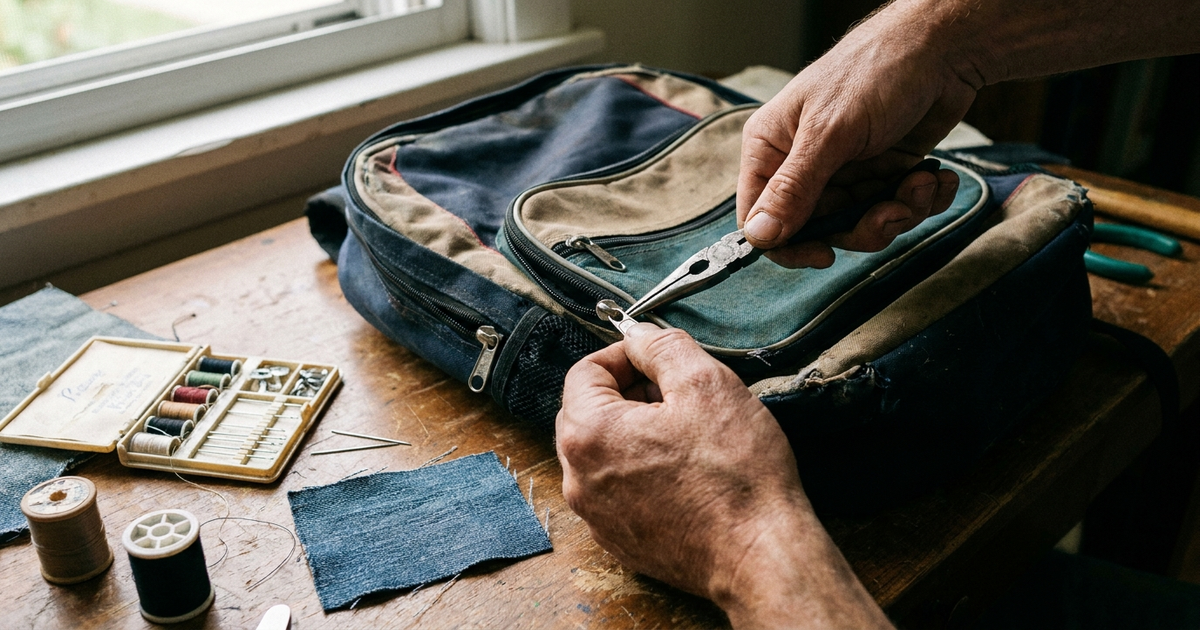
The zipper slides but pops open behind the pull — is it broken?
Almost never. If the teeth are intact and the gap opens up a few inches behind where the pull tab sits, the slider itself has widened with wear and stopped gripping the teeth. Updated 2026 repair guides agree on the fix: squeeze the back of the slider gently with pliers — a little at a time, testing after each squeeze — until it grips the teeth again. Replacing the whole zipper is only necessary if teeth are actually missing or bent. (A Broken Backpack, 2026)
The zipper came off the track, or the pull broke off
If the slider has come off one side of the track entirely, work it back on from whichever end is still closed, feeding both rows of teeth into the slider's channel at the same angle they'd meet at the base — forcing it from the middle just jams it further. If only the pull tab snapped off but the slider itself still works, a keychain ring, a paperclip bent into a loop, or a shoelace tied through the slider's hole all work as a permanent-enough fix, no tools required — useful if the break happens at a locker between classes rather than at home.
Zippers, buckles, holes, and strap stitching are also the four repairs The Daily Sew walks through across three real backpacks in the video below.
The shoulder strap stitching ripped out
You don't need a machine for this one. A hand-sewn box stitch — a rectangle with an X inside it, sewn through the strap webbing and the anchor tab with heavy-duty upholstery or bonded nylon thread, not regular sewing thread — spreads the load across enough stitches that it holds under a full bag of textbooks. Regular thread is the most common reason a DIY strap repair fails again within weeks. (iFixit strap repair guide)
A plastic side-release buckle snapped
Buckles are sized by the webbing width they clip onto (commonly 1", 1.5", or 2" on school bags), stamped or molded near the buckle's hinge. Measure the strap width before ordering a replacement rather than guessing from the broken piece, since a slightly undersized buckle will slip and an oversized one won't thread through the webbing loop. No sewing is required — most replacement buckles are designed to loop the existing webbing through and back on itself.
There's a hole or a worn-through corner
A self-adhesive nylon repair patch or a small nylon mend sewn over the hole handles most tears. The step people skip: running a bead of seam sealer over the stitching or patch edges afterward. A sewn patch is not waterproof on its own — the needle holes let water through even when the patch itself is coated fabric — so if the spot sits low on the bag where puddles and wet grass reach it, seal the stitch line, not just the tear. (Mountain Warehouse repair advice)
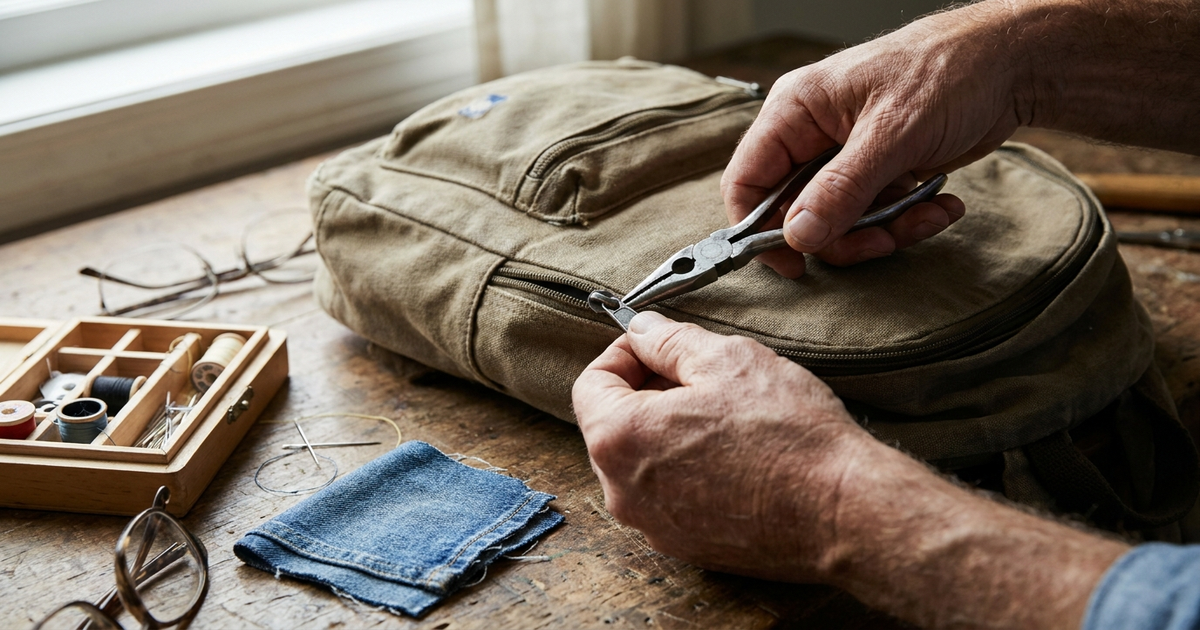
Repair or replace? A quick way to decide
Buckles, zippers, pull tabs, and strap stitching are almost always worth repairing — they're mechanical parts, cheap to fix, and fixing them doesn't touch the rest of the bag. Replace the bag instead when the waterproof coating is peeling or tacky across a large area, the internal frame or back panel has cracked, or you're already stacking a second and third repair onto a bag that cost very little in the first place. One owner who reinforced the worn-through bottom of an eight-year-old daily backpack for roughly 20% of the price of a new one summed up the calculation well: they said they liked the repaired bag more than a new one would have been. That math holds for a well-made bag; it doesn't hold for a $15 bag with a $20 problem. (The Cool Down, July 2026)
If you'd rather pay a cobbler
Backpacks are a recognized seasonal repair line for shoe and luggage repair shops around back-to-school — replacing zipper sliders or full zippers and patching fabric to match the original material. Shops report it's routinely cheaper than buying a new bag of comparable quality, which is the same math as the DIY case above; you're just paying for the labor instead of doing it yourself. (SA Shoe & Luggage Repair)
If the bag is a lost cause, our roundups of recycled material backpacks and laptop backpacks for students cover options built to survive the next few years of daily wear. And if a replacement's tag mentions recycled content, our GRS certification explainer covers what that label actually verifies.
Transparency note: This article was researched and written by Chester Takau with AI assistance for research gathering and drafting. All recommendations reflect the author's own editorial judgment.
Related on TokMind: How Long Should a School Bag Last? A Realistic Timeline by Type
Comments
Post a Comment